
1976 was a year that had it all. Rocky started filming, Nadia Comăneci stuck a perfect 10 and Viking 1 quietly landed on Mars, changing space exploration forever. Disco was king on the airwaves, with Wings, Elton John and the Bee Gees—as well as bell-bottoms—ruling the dance floors. The Apple I had just gone on sale, all 200 units of it, for $666.66. Nobody called it a revolution yet. And in the White House, a peanut farmer from Georgia named Jimmy Carter was about to upset the world’s most powerful incumbent, proving the year had no interest in playing it safe.
Meanwhile, twin sisters in San Francisco were boiling rose petals into what would become the beauty icon we now know as Benefit, Anita Roddick was opening an ethical beauty shop in London and a young Frenchman in Provence was dreaming of lavender fields. Not bad for a single trip around the sun.
The Brand a Coin Toss Built: Benefit
Twins Jean and Jane Ford stood at a crossroads in 1976, literally. Fresh off careers as models and makeup artists, the Indiana-born sisters had landed in San Francisco with two ideas and a coin. Heads: a casserole café. Tails: a beauty boutique. The coin landed, and the world got what we now know as Benefit Cosmetics.
The boutique they opened in the Mission District went by The Face Place back then, and it was exactly that: an intimate, joyful space where beauty felt approachable, personal and a little bit irreverent. “At a time when the beauty industry often felt serious and intimidating, Jean and Jane took a different approach,” the brand reflects. “They believed beauty should be approachable, playful and fun. Their philosophy was simple: Laughter is the best cosmetic.”
Their first product told that story perfectly. Benetint, a rose-tinted lip and cheek stain that has since become a cult icon, was born from an unusual request: a dancer who needed color that stayed put. It was unconventional, clever and completely original. In other words, very Benefit.
By 1990, The Face Place had evolved into Benefit Cosmetics—a name inspired by the Italian word bene, meaning good—and the sisters were expanding into department stores, including Henri Bendel in New York, then Harrods in London. But it was brows that truly cemented Benefit’s place in the beauty canon. When the brand opened its first Brow Bar at Macy’s Union Square in 2003, bringing waxing out of the back room and into the window for all to see, it didn’t just offer a service. It started a movement.
Today, Benefit is the number-one brow brand in the world, with more than 3,000 Brow Bars across more than 50 countries. “Our continued relevance comes from staying connected to our customers while remaining true to who we are,” the brand says. “That combination of performance and playfulness has helped us build lasting connections across generations of beauty lovers.”
Now part of the LVMH family, Benefit has scaled in ways Jean and Jane might never have imagined when they flipped that fateful coin. With more than 3,200 locations worldwide and iconic products like They’re Real! mascara, Hoola Bronzer and the POREfessional primer, the brand has earned devoted followings across generations. Its philanthropic arm, Bold is Beautiful, has donated more than $25 million to organizations supporting women and girls since 2015. Fifty years on, the original spirit has held—warm, witty, a little wink-and-nudge, even at global scale. “Beauty is about more than products,” the brand says. “It’s about confidence, self-expression and creating moments of joy.”
Tails, it turns out, was the right call.
Born in a Little Green Storefront, Destined to Change the Planet: The Body Shop
There are origin stories, and then there is the story of The Body Shop. In 1976, Anita Roddick, a mother, traveler and relentless idealist, opened a small green storefront on Brighton’s North Street with just 25 products, hand-labeled in simple bottles, some filled with sawdust to stretch the supply. She wasn’t launching a beauty brand. She was paying the bills while her husband Gordon rode a horse from Buenos Aires to New York. What she accidentally launched was a revolution.
From that first modest shop, Roddick drew on a lifetime of wandering. She had traveled the world, studying how women in different cultures cared for their bodies—not with synthetic chemicals and elaborate promises, but with ingredients pulled straight from the earth: cocoa butter rubbed into skin in Tahiti, rhassoul mud used in Moroccan hammams, tea tree oil wielded across Aboriginal Australia. She believed these were the real secrets of beauty, and she was going to bottle them honestly and affordably.
The early years were scrappy. When a local funeral parlor threatened to sue over the name “Body Shop,” Roddick called a reporter and turned the controversy into free press. It was a preview of the audacious spirit that would define the company for decades to come.
What distinguished The Body Shop from every other beauty company of its era wasn’t simply the ingredients. It was the philosophy that bound them together. At a time when the industry ran on manufactured insecurity, Roddick refused to play along. Her stores didn’t sell miracle transformations or impossible ideals. They sold products that worked, sourced with care, from people who were paid fairly.
The Community Fair Trade program, which Roddick pioneered years before “ethical sourcing” became a marketing buzzword, established direct partnerships with producers around the globe—shea butter from women’s cooperatives in Ghana, paper from Get Paper Industries in Nepal, recycled plastics from Plastics for Change in India. Each ingredient carried a story, and The Body Shop made sure customers heard it.
By the time other brands were discovering sustainability, The Body Shop had been living it for a decade. Refillable bottles became a symbol of environmental commitment. And on animal testing, the brand was decades ahead. It was one of the first cosmetics companies in the world to prohibit ingredients tested on animals, long before it became law in many markets.
The Body Shop’s campaigns were legendary. In the 1980s, when the beauty industry still insisted that thinner was better and wrinkles were the enemy, Roddick put a full-figured doll in her stores under the slogan: “There are three billion women who don’t look like supermodels and only 8 who do.” The press went wild. Customers loved it.
The brand’s “Stop the Burning” campaign took on Amazonian deforestation. Its work against domestic violence spanned the globe. Its Self-Love Uprising challenged a beauty culture that, as the brand put it, pitches women into “a war with their own bodies.” At The Body Shop, buying a bottle of vitamin E cream was, in some small way, a political act.
Amid all the activism, it’s easy to forget that The Body Shop also simply makes extraordinary products—ones that have outlasted trends, ownership changes and decades of industry disruption. There’s the Hemp Hand Protector, beloved by nurses, gardeners and anyone whose hands meet the world directly. The Vitamin E Moisture Cream ($32), which boosts hydration by 38 percent for eight hours and has earned its place on bathroom shelves across generations. The Shea Body Butter ($32), promising 96 hours of moisture and, by most accounts, delivering it. The White Musk fragrance ($42), launched in 1981, was one of the first cruelty-free musks on the market and remains a bestseller today. The Chamomile Cleansing Butter removes even stubborn makeup in under 30 seconds.
The Body Shop turns 50 in 2026, and it does so having navigated complicated terrain. But what has not changed is the founding spirit. Today, the brand describes itself as “vivacious, energetic, courageous, outrageous” and somewhat defiantly points out that while others have followed, The Body Shop led. It is a claim with evidence. Animal testing bans, fair trade sourcing, body-positive messaging, refillable packaging and activist campaigns are now industry standards precisely because one green shop in Brighton insisted, loudly and often, that they should be.
From a Market Stall to the World: L’Occitane en Provence
Half a century ago, a 23-year-old dreamer named Olivier Baussan was doing something quiet, but remarkable. In the sun-drenched fields of Haute-Provence, he began distilling rosemary and selling essential oils at local markets, guided by little more than curiosity, a love of plants and a deep respect for the land beneath his feet.
That simple, almost instinctive gesture would become the founding spark of L’Occitane en Provence. By 1977, the first boutique had opened in Manosque, a small town in the heart of Provence, and the seeds of a global beauty Maison were planted.
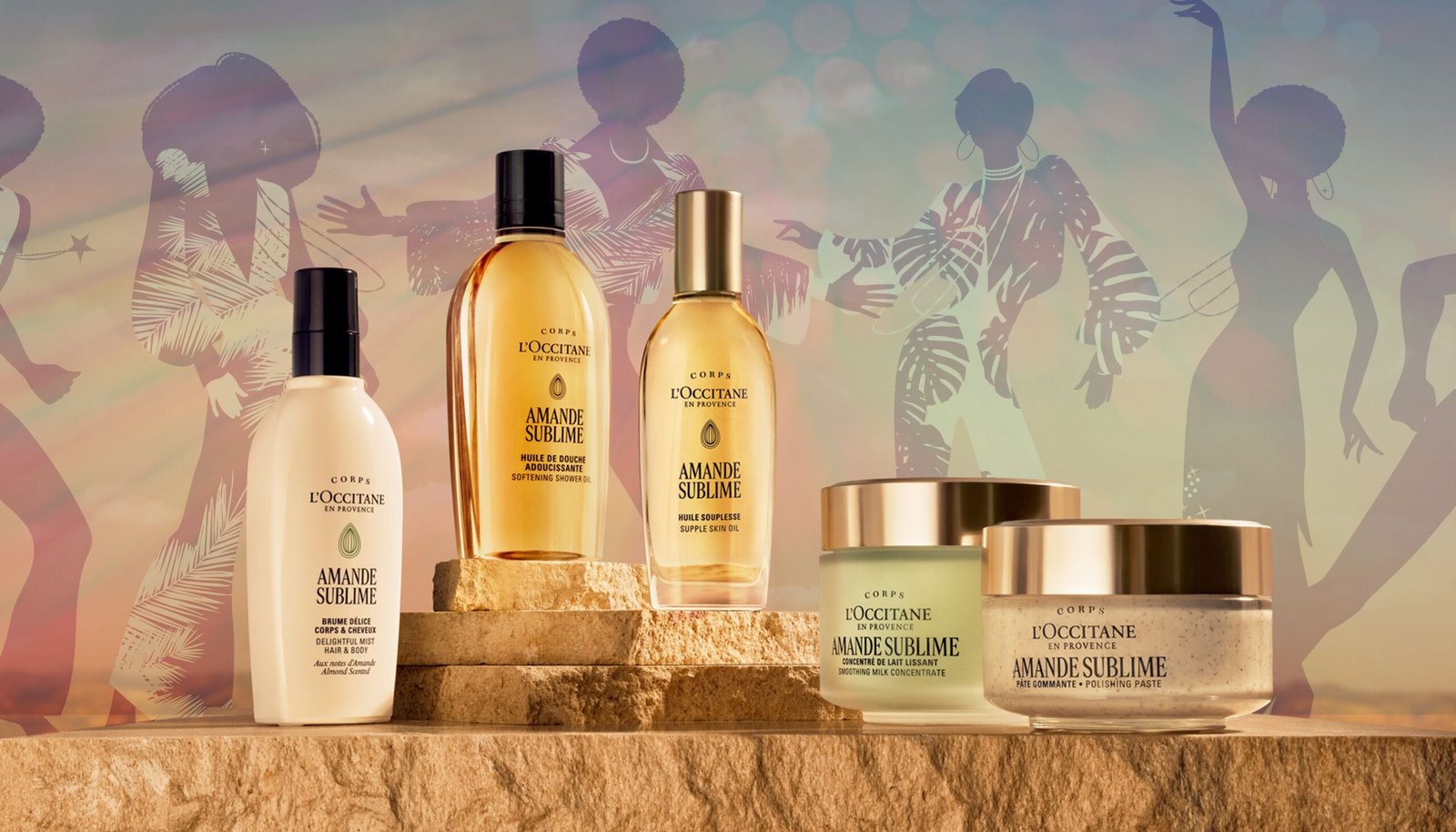
Fifty years later, L’Occitane has grown from a market stall into a brand with more than 3,000 boutiques worldwide, 100 spas and 2,500 partner hotels, yet its values have never strayed far from those lavender-scented origins. Ingredients like shea butter, almond and immortelle remain at the heart of the brand’s philosophy, each one transformed through a blend of centuries-old craftsmanship and modern science into something deeply sensory and intentional.
Now, in 2026, L’Occitane marks its golden anniversary not with nostalgia, but with reinvention. A refreshed identity, reimagined fragrance collections and relaunched body-care lines—including the beloved Shea Butter range, now reborn as the Karité Confort Collection—signal a brand stepping boldly into its next chapter. As CEO Adrien Geiger puts it, half a century ago the brand was built on the belief that “nature, craft and community could give rise to something deeply meaningful.” Five decades later, that belief is very much alive.